Start a Creative Habit with a Small Repeatable Practice
Build a creative routine around one clear action, a reliable cue and a gentle way to adapt when your schedule changes.
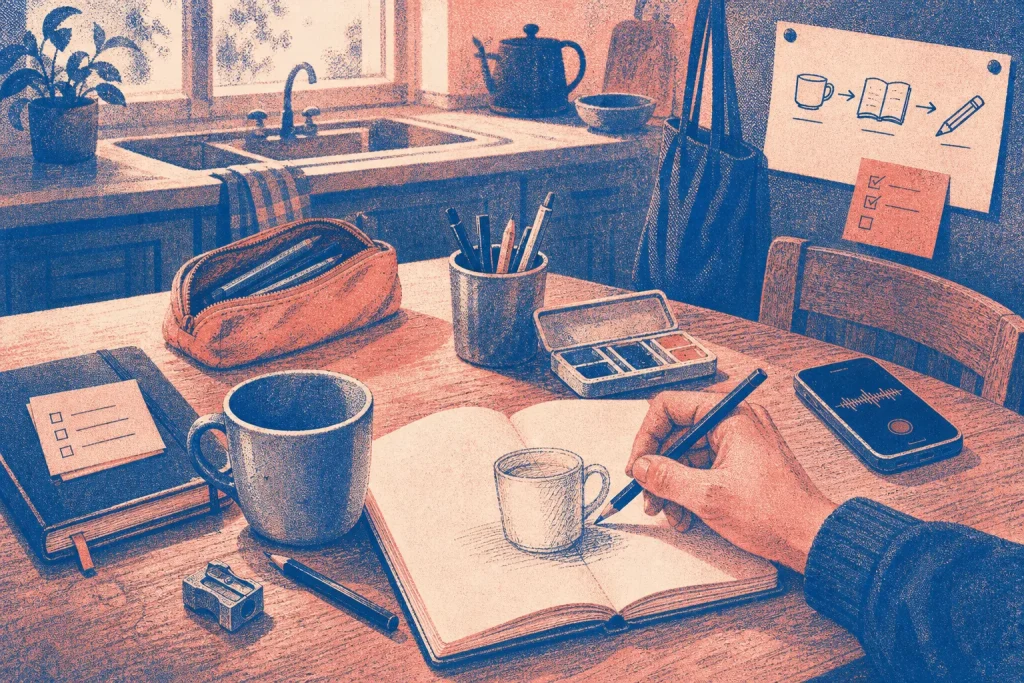
At the end of a busy day, a sketchbook is open on the kitchen table, but the plan to draw for an hour feels impossible. A smaller invitation—draw one cup, using a pencil already beside the book—can be easier to accept. The point is not to make the work impressive or to turn every spare moment into productivity. It is to make creative activity easy to begin and flexible enough to survive an ordinary week.
A creative habit is a repeatable arrangement: a particular activity, a cue that helps you start, and a modest definition of what counts as showing up. It does not require daily practice, a streak, or a polished result. The arrangement should fit the life you have, including interruptions. Once the starting action is clear, you can adjust the schedule without abandoning the practice altogether.
Choose an activity with a visible starting action
“Be more creative” is a wish, not an activity. “Write a paragraph,” “mix two colors,” or “play a chord progression” describes something you can begin. Look for an activity with a physical first move and materials you can reach without a lengthy setup. A notebook and pen, a phone’s voice recorder, a small set of watercolors, or a guitar kept on a stand can all reduce the distance between intention and action.
Start with what draws your attention, not what seems most impressive. If you want to make music but have little time, you might hum a melody into a recorder rather than commit to learning a full arrangement. If you enjoy photography, a short walk with one visual prompt may be more inviting than a complicated editing workflow. The practice can grow later; at first, it needs to be easy to enter.
Consider the difference between an activity and its outcome. “Finish a short story” depends on how long the story takes and how much revision it needs. “Write a few sentences in a scene” is an action you can complete in one sitting. Outcomes can provide direction, but they are often poor measures of whether a routine is workable. Make the repeated action small enough that it remains meaningful even when the result is unfinished.
Set a minimum that still feels like making something
A minimum practice is the smallest version you are willing to count as a real session. It should be brief, but not so vague that it becomes a token gesture. “Think about drawing” has no clear endpoint. “Make three thumbnail sketches of a window” leaves a visible trace and gives you a natural stopping point. For writing, the minimum might be drafting one exchange of dialogue. For music, it might be playing one passage slowly and noticing where it catches.
Keep the minimum modest enough for a difficult day. Then decide what an ordinary session looks like when you have more room. You might write one paragraph as the minimum and continue into a longer scene when energy allows. This creates a range instead of an all-or-nothing rule. Stopping after the minimum is allowed; continuing is an option, not a debt you owe the routine.
A useful minimum also respects the kind of work involved. A craft practice may need time to lay out materials and clear them away. A writing session might need a quiet place, while a melody can be recorded in a voice memo. Include the real setup in your plan. If reaching the activity requires searching for supplies, opening several apps, or deciding what to do from scratch, simplify the setup or prepare a ready-to-use starting point.
Anchor the practice to a cue you already encounter
Choose a cue that naturally occurs in your day: after making tea, when you sit down after work, or before you close your laptop for the evening. A cue is more reliable when it is specific and already part of your routine. “When I have free time” leaves the starting moment to chance. “After I put my breakfast bowl in the sink” gives the practice a clearer place in the day.
Connect the cue to a prepared first action. After the bowl goes in the sink, you might bring a notebook to the table and write one observation from the morning. If you want to paint, leave a sheet of paper and a brush beside a jar for rinsing. If you compose digitally, pin the current project or place a note on the desktop naming the next small change. The aim is not to make your space elaborate; it is to remove a few decisions that otherwise delay starting.
Time can help, but a rigid clock time may not suit shifting schedules. If your mornings vary, use an event rather than a particular hour. You can also name a backup cue: if the morning session disappears, try the practice after lunch. A backup should make participation easier, not create two appointments you feel obliged to fulfill.
Use a small menu to avoid deciding from zero
Creative energy is uneven, and the task that feels inviting on one day may feel demanding on another. Prepare a short menu of actions that serve the same broad interest but ask for different kinds of effort. A writer might choose between describing a place, revising a sentence, or collecting a line of overheard dialogue. A musician might improvise, learn a phrase by ear, or record a rhythm. A visual artist might sketch from observation, experiment with color, or arrange a small still life.
Keep the menu compact enough to scan quickly. Too many choices can turn the beginning into another planning session. Label options by the kind of attention they need, such as “quiet,” “playful,” or “low energy.” You can then match the practice to the day without changing the underlying habit. The goal is to preserve contact with the activity while letting the form of that contact vary.
It can also help to end a session by leaving a note for your future self. Write the next action directly on the page or save a voice memo that names the next musical experiment. “Try the second line with a slower rhythm” is easier to pick up than “work on song.” A clear handoff reduces the amount of fresh planning required when you return.
Adjust the routine when life gets busy
When your schedule tightens, first identify what changed. Perhaps the available time shrank, the usual space became noisy, or the materials are inconvenient to access. Each problem suggests a different adjustment. A shorter session helps with limited time; a quieter alternative location helps with noise; a prepacked pouch or digital file can address setup friction.
Keep the activity recognizable while changing its scale. A long writing session could become a paragraph in a pocket notebook. A planned photography walk could become one deliberate photograph on the route you already take. If even the smallest version feels out of reach, pause without treating the interruption as proof that the habit has failed. Choose a return cue—such as the first evening at home after a demanding stretch—and prepare the next action before that moment arrives.
A skipped session is information, not a verdict. If a cue repeatedly arrives when you are tired, move the practice to a more workable part of the day. If the activity feels like another obligation, ask whether the minimum has become too demanding or whether the menu needs a more playful option. Changing the arrangement is part of maintaining it. The practice should support creative attention, not become a test of character.
Notice the quality of attention, not just completion
A quick record can help you see whether the routine fits. Note the date, what you did, and one observation: “sketched the plant; easier after dinner,” or “recorded a melody; needed headphones.” Avoid turning the record into a score. Its purpose is to reveal useful patterns and remind you what you have been exploring, not to rank your discipline.
After a while, ask whether the cue is dependable, whether the materials are ready, and whether the minimum produces a satisfying point of contact with the activity. If the answer is no, change one element at a time. Moving the notebook to a more convenient room may be enough. Replacing the whole plan each time it feels imperfect makes it harder to learn which part needs attention.
Make room for curiosity, too. A repeatable practice is a container, not a demand that every session look alike. You can follow an unexpected idea when it appears, while keeping a simple default for days when nothing comes immediately. That balance—some direction without a fixed outcome—helps a habit remain both sustainable and creative.
A hypothetical example of a flexible writing routine
Imagine a person who wants to write fiction but has an unpredictable evening schedule, a shared kitchen table, and only a notebook and pen that can be put away quickly. Their starting point is a broad intention to “write more,” which is difficult to act on when the day has already been busy. They choose one repeatable activity: draft a small moment in a scene. Their minimum is a few sentences, and their ordinary session can continue if the scene begins to move.
They connect the practice to putting a mug in the sink after dinner. Before the week begins, they place the notebook in a drawer near the table and add a short menu to its first page: describe a room, write a line of dialogue, or revise one sentence. On a demanding evening, they choose dialogue and stop after the minimum. On a quieter evening, they continue the scene. If the kitchen is occupied, they use the same notebook in a chair elsewhere rather than waiting for a perfect workspace.
Suppose the dinner cue keeps arriving too late on nights when the schedule changes. The person can move the cue to a more dependable transition, such as sitting down after arriving home, while keeping the same small writing action. The expected result is a routine with fewer setup decisions and a clear way to scale down. The tradeoff is that some sessions will remain brief and the story may develop unevenly; that is preferable to making every session depend on having an uninterrupted evening.
Start by deciding what you want to make, what the smallest satisfying action would be, and which existing event can prompt it. Put the materials where that action is easy to begin, then give yourself permission to adapt the plan when circumstances change. A creative habit becomes useful not because it demands a flawless schedule, but because it offers a practical way back to the work.
Keep exploring
A Room-by-Room Guide to Reducing Household Clutter
Sort household belongings by what each space is for, then decide what to keep nearby, relocate,…
Why Everyday Objects Become Design Classics
A chair in a neighborhood café shows how useful form, durable materials and repeated encounters can…