A Room-by-Room Guide to Reducing Household Clutter
Sort household belongings by what each space is for, then decide what to keep nearby, relocate, or let go without turning the whole home upside down.
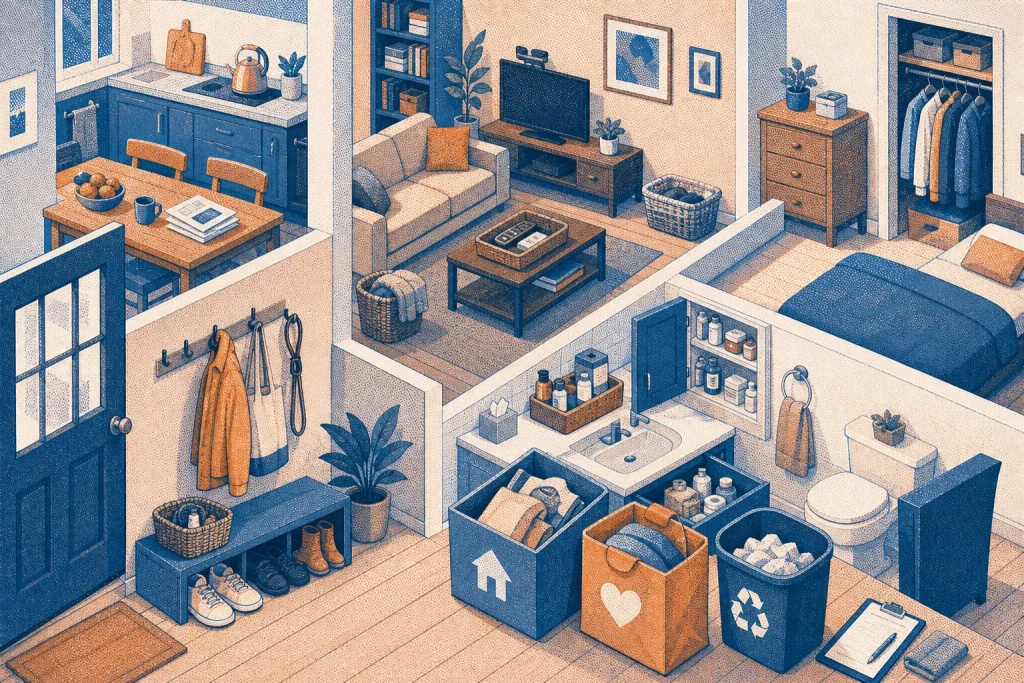
A mug balanced on the bathroom counter, a stack of mail on the dining table, and a basket of shoes beside the front door can make a home feel crowded even when each item has a sensible reason for being there. The useful question is not simply, “Do I own too much?” It is, “Does this belong here, and can I use this space as intended?” Sorting one room at a time makes that question easier to answer.
Set out a few containers before you begin: a box for items to relocate, a bag for things to donate or give away, and a bin for rubbish or recycling. Keep a cloth and a small notepad nearby. Work in a short, defined area rather than emptying every cupboard at once. The order below follows the way many households move through their rooms, but adapt it to your own layout and routines.
Start with the entryway and choose what must be easy to reach
The entryway handles arrivals and departures, so it tends to collect objects that need a temporary landing place. Begin with the floor, then look at hooks, a console table, shoe storage, and any nearby basket. Put each item in one of three groups: used for leaving the house, needed elsewhere, or ready to leave the home.
Keep the things that support your actual routine close to the door: perhaps daily shoes, a coat, keys, a reusable shopping bag, or a leash. Move occasional-use items to a cupboard or closet. If the entryway has no built-in storage, a shallow tray for keys and a single basket for outgoing items may be more useful than adding several organizers.
Check the route through the doorway. A bag or umbrella that blocks the path is not well stored, even if it has a designated spot. Place relocation items in your box, but do not let the box become permanent storage; carry it to its destination before starting another room.
Clear kitchen surfaces before opening cupboards
In the kitchen, start with work surfaces and the table. Return tools and ingredients to their usual storage, and move unrelated items to the relocation box. Then decide which objects deserve to remain within easy reach. A kettle, a chopping board, or the pan used for regular meals may earn a place on the counter; rarely used appliances may work better in a cabinet.
Next, open one cupboard or drawer at a time. Group like items together: cooking utensils, food containers, mugs, baking tools, or pantry ingredients. This reveals duplicates and makes it easier to see whether the storage space is being used for the right things. Let go of broken items that cannot reasonably be repaired, and set aside usable pieces you no longer need to donate or pass on.
For food, check labels and condition rather than relying on memory. Discard anything spoiled, and place items you plan to use soon where they are visible. Follow the package directions and ordinary food-safety guidance when deciding whether something is still suitable to eat. If a cupboard is hard to use, a simple shelf divider or a clearly labeled basket may help, but first remove what does not belong there.
Give the living room clear surfaces and useful storage
Living rooms often serve several purposes: reading, relaxing, playing, or hosting. That means clutter can come from different routines rather than from one category of possessions. Gather loose items by type, such as books, toys, chargers, blankets, and remote controls. Return each group to the place where it is most likely to be used.
Keep frequently used items accessible, but avoid filling every shelf and table. A basket beside the sofa can hold a current knitting project or a few toys; a small tray can corral remotes. These containers work best when they have a clear limit. If the basket overflows, choose which project or toys belong in the room instead of adding another container automatically.
Look at decorative objects individually. An item can be meaningful and still be better displayed elsewhere, stored safely, or passed to someone who will use it. You do not need to make every decision immediately. Put uncertain objects in a small, dated box, then revisit them after you have lived with the clearer room for a while.
Sort bedrooms by daily routine, not by storage capacity
In a bedroom, begin with the bedside area and the top of dressers. Keep only what supports the routine there: a book in progress, reading glasses, a lamp, or a small dish for jewelry. Move laundry, dishes, paperwork, and other out-of-place items to the rooms where they belong.
For clothing, work through one category at a time instead of pulling everything from the closet. For example, gather shirts, assess them, then move on to trousers or sweaters. Keep clothes that fit your present life and that you are willing to wear. Set aside clean, usable garments that no longer suit you for donation or hand-me-downs. Damaged pieces can be recycled where a suitable local program exists, or discarded according to local waste rules.
Make storage decisions around access. Put everyday clothes where you can reach them without moving seasonal items or special-occasion wear. A drawer divider can help keep socks together, but it will not solve a drawer crowded with clothes you never choose. Reduce the contents before changing the storage system.
Make bathrooms easier to clean and restock
Bathroom counters and cabinets are easier to sort when you take out a small section at a time. Group toiletries, medicines, grooming tools, towels, and cleaning supplies separately. Wipe the cleared surface, then return only the items used in that room.
Check containers for leaks, damage, or products you no longer use. For medicines you no longer need or that have expired, use a pharmacy or other authorized take-back option where available, and follow its instructions. If no take-back option is available, consult the medicine label and local health or waste authority for disposal guidance; do not assume that flushing or placing medicines in household rubbish is appropriate. Keep medicines in their original, clearly labeled containers and store them as the label directs, out of reach of children and pets. For household chemicals, follow label directions for storage and disposal, keep them in their original containers, and do not mix products. Contact a pharmacist, poison-control service, local waste authority, or other qualified local professional if the instructions are unclear or safe disposal is uncertain.
Keep everyday toiletries in an accessible place and occasional items together in a labeled container. Avoid transferring products into unmarked bottles, which can make contents harder to identify. If several partly used products do the same job, decide which one you will finish and remove the rest from the active storage area.
Finish with shared spaces and the relocation box
Hall closets, laundry areas, and spare rooms often become catchalls because they are used by everyone or have flexible purposes. Decide what each area is for before sorting it. A hall closet might hold coats and household supplies; a laundry shelf might hold detergent and stain-treatment tools. Keep items that support those uses together, and move unrelated belongings to their proper rooms.
Now empty the relocation box. Carry each item to its destination, rather than setting the box down in another room. Put donations near the door or in your car if that makes the next handoff easier, and separate rubbish from recycling according to local rules. If something has no clear destination, decide whether it is genuinely needed. A useful item without a practical place may be a candidate to give away.
Before finishing, walk through the rooms you sorted. Check whether doors and drawers open freely, surfaces can be used, and the items you rely on are easy to find. These are better signs of progress than a perfectly uniform set of containers.
Use a small decision rule when you get stuck
For each item, ask three questions: Does this space support its use? Do I use it or have a specific reason to keep it? Is there a realistic place for it? If the space is wrong, relocate it. If it has a purpose and a sensible home, keep it. If it no longer serves a purpose, let it go through donation, recycling, or disposal as appropriate. When the answer is uncertain, set the item aside in a limited, labeled holding box rather than interrupting the whole session.
Hypothetical worked example: Imagine a small apartment kitchen where a baking sheet, an unused blender, and a pile of incoming mail share one counter. The resident needs the counter for meal preparation, uses the baking sheet regularly, and has not used the blender for a long time. They move the mail to a designated paper tray near the desk, store the baking sheet vertically in a cabinet, and set the clean blender aside for donation. The expected result is a clearer preparation surface, with the tradeoff that occasional blending will require borrowing or replacing the appliance if that need returns.
Clutter often returns when a home has no easy place for everyday arrivals. After sorting, choose one modest habit that fits your routine: clear the kitchen table before bed, return shoes to the entryway, or empty the relocation tray during a weekly reset. A dependable place and a brief return-to-home routine can keep rooms useful without demanding a major overhaul every time life gets busy.
Keep exploring
Start a Creative Habit with a Small Repeatable Practice
Build a creative routine around one clear action, a reliable cue and a gentle way to…
Why Everyday Objects Become Design Classics
A chair in a neighborhood café shows how useful form, durable materials and repeated encounters can…