Why Everyday Objects Become Design Classics
A chair in a neighborhood café shows how useful form, durable materials and repeated encounters can help an ordinary object become a shared cultural reference.
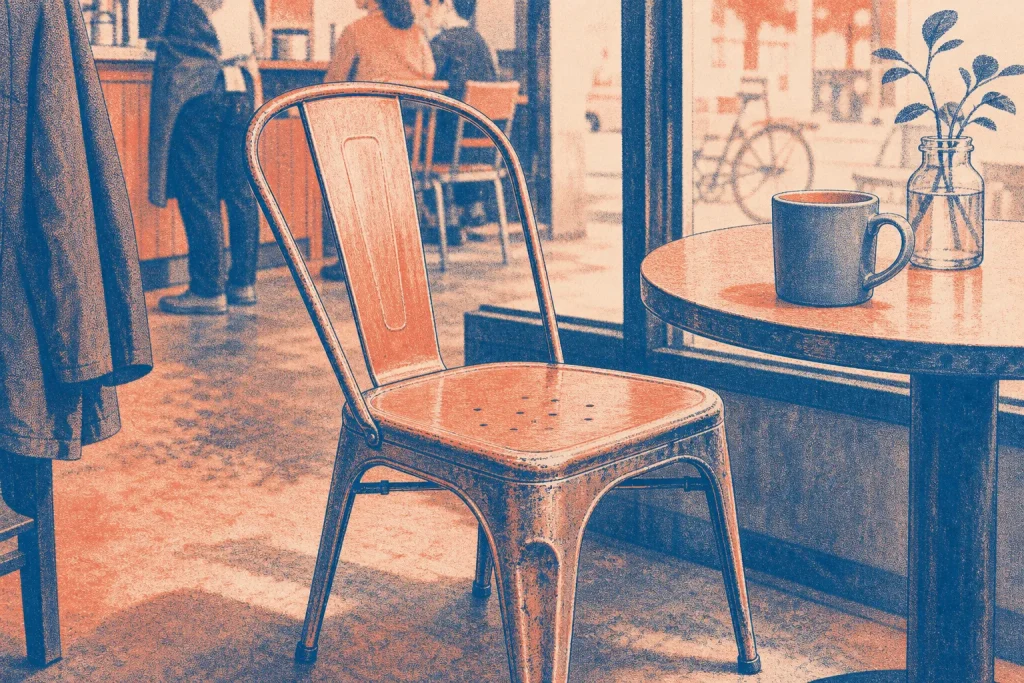
At a neighborhood café, a metal chair sits beside the window, its painted frame worn smooth where customers pull it across the floor. Nobody came in to admire it. They chose it because it was free, it held a coat, and it offered a place to wait. Its shape may remind someone of a school hall, a kitchen or a station. That recognition can be one ingredient in an object’s reputation, though no single quality makes a design classic.
To see how this might happen, imagine a fictional café replacing its mismatched seating with one simple chair. The scenario is invented, not a report of a real business or a test. Following the chair from selection to daily use helps distinguish practical design choices from the cultural meanings people may attach to an object.
Use gives people a reason to encounter an object
The café’s owner, Mara, needs a chair for a narrow room with frequent deliveries and a small staff. It should slide beneath a table, be manageable to move and feel stable on a hard floor. A sculptural seat that looks striking in a showroom but is awkward to lift would not suit this particular task. Function—the work an object is meant to do and how its features support that work—gives people a reason to keep using it.
For a chair, function includes supporting a person in its intended setting and being practical to move. For a kettle, it might include pouring with a comfortable grip. An object can also serve a social purpose: a bench invites people to sit together, while a small table offers a place to set down a cup.
Mara’s imagined choice is a compact chair with a curved back, a simple tubular frame and a seat that can be wiped clean. The outline is not just decoration added after practical decisions. The curve gives the chair a recognizable profile, while the frame keeps its appearance visually light. Whether those features work well depends on the chair’s construction and the needs of its setting.
Usefulness does not by itself make an object culturally memorable. Many serviceable things attract little notice. But repeated encounters may give people opportunities to recognize a form. Someone who has sat on a similar chair at school might notice it without knowing its maker or design history. That association is personal and may not be shared by everyone.
Materials shape appearance and everyday care
The imagined chair’s materials affect both its appearance and its everyday character. A metal frame can look spare and feel firm; a molded seat can offer a smooth surface that is easy to clean. These qualities come with possible drawbacks. Metal may feel cold to the touch, and a hard seat may be uncomfortable during a long visit. No material is best for every use. The choice depends on the object’s purpose, maintenance and setting.
Materials also affect how a form changes with use. Painted surfaces may chip where they meet a table. Wood can darken or show marks, while plastic can become scratched. People may read these changes as wear, neglect or character, depending on the object and its surroundings. The useful question is whether ordinary care is manageable and whether the object remains fit for its intended use.
Mara’s fictional café has a practical constraint: staff need to wipe the chairs between customers, and bulky seats would obstruct movement in the narrow room. She considers an upholstered chair, then sets it aside because its fabric would require a different cleaning routine. That is a local decision, not a general rule against upholstery.
Materials may also suggest associations. Some people connect wood with craft or domestic warmth; others may read polished metal as industrial or precise. These meanings vary with experience and context. When a material seems suited to an object’s purpose, the combination may feel convincing, but that response is not universal.
A legible form is easier to recognize
Form is the arrangement of an object’s visible parts: its outline, proportions, surfaces and details. A clear form need not be plain. It can include a distinctive curve or joint, provided that feature feels connected to the whole. On Mara’s imagined chair, the curved back and slender frame create an outline a customer might recognize from across the café.
People may remember a shape more readily than a technical description. They might recall a bentwood back, a round wall clock or a kettle with a particular handle, then recognize a related object elsewhere. This is one possible way a design becomes a visual reference that people describe, draw or imitate.
Distinctiveness has limits. If every part competes for attention, an object may be difficult to read or awkward to live with. A chair with unusual legs, a dramatic back and elaborate decoration might stand out in a photograph but prove inconvenient in a small café. A restrained design can also disappear into its surroundings. The balance between clarity and visual interest is a matter of context and taste.
A form’s meaning can differ from one place to another. A chair that feels familiar in a school cafeteria may seem formal in a home. Associations with public waiting rooms, kitchens or classrooms depend partly on where people encounter similar objects. Design interpretation therefore involves more than appearance: people bring their own experiences to a form.
Familiarity can become a shared reference
In the invented café, customers encounter the chair in ordinary ways. Someone moves it aside to make room for a stroller. A worker turns it toward the counter. A child traces its back while waiting for a drink. These imagined moments illustrate how recognition might arise from repeated, everyday encounters rather than one dramatic event.
Familiarity is not universal approval. One customer may find the chair comfortable; another may prefer a padded seat. Someone might associate its outline with a school cafeteria, while someone else connects it with a community center. If a form becomes a shared reference, that does not mean everyone likes it or remembers it in the same way.
Consistent production and use may make a form easier to encounter, but cultural recognition cannot be inferred from a designer’s intention or an object’s placement in a prominent room. People might see an object in daily settings, encounter similar forms or notice images of it. Whether those encounters add up to a wider cultural association is an interpretation that depends on the people and contexts involved.
Reproductions and adaptations may extend a form’s reach, while making its history less clear. A shape might become familiar as a general type rather than as the work of a particular designer or maker. That distinction matters when discussing attribution. It also cautions against treating familiarity alone as proof of a design’s status.
A hypothetical choice reveals practical tradeoffs
Starting situation: In this invented scenario, Mara is fitting out a narrow neighborhood café. She needs chairs that staff can move, wipe with a damp cloth and tuck beneath small tables. The room has a hard floor and limited storage. Her options are a bulky upholstered chair, a lightweight folding chair and a compact chair with a curved back and sturdy frame. These are hypothetical options, not claims about actual products.
Actions: Mara sets aside the upholstered option because fabric would add a cleaning task in this particular routine. She rejects the folding chair because she does not want its visible hinges and stacked shape in the room. She chooses the compact chair, then checks that it sits steadily on the floor, that a staff member can lift it comfortably and that its seat and frame can be wiped with the materials already used for cleaning. She places the chairs around the tables rather than treating one as a display piece.
Result and tradeoff: In the scenario, the compact chair fits beneath the tables and can be cleaned with the café’s existing routine. Its curved outline gives the room a consistent visual feature, but the seat feels firmer than the upholstered alternative. Mara keeps the choice for the café’s shorter visits and decides that a padded seat would be more suitable in a quieter corner intended for longer stays. The decision solves one set of needs while accepting a comfort tradeoff; it does not establish that the chair will become culturally significant.
This example shows how design judgments depend on a setting. The chair need not suit every room or every person. Mara’s decision is based on the café’s space, cleaning routine and intended use. If customers later recognized a similar outline elsewhere, that recognition would be one possible association—not an outcome she can assume in advance.
Continued use is only one part of an object’s reputation
An object can look striking in a photograph and still be inconvenient in daily life. It may be difficult to repair or poorly suited to the spaces where people need it. Another object may be so ordinary that its visual qualities go unnoticed until a similar form appears elsewhere. An object’s reputation may reflect a mixture of practical use, visual character, historical context and personal association.
Repairability can affect whether an object remains in use. A chair with an accessible joint may be easier to maintain than one that cannot be opened without damaging it. A replaceable part can make a repair more feasible. The same consideration applies to household objects such as lamps or utensils. These details do not decide whether an object is a classic, but they can influence how people encounter it over time.
There is no single recipe for a design classic. Some objects are remembered for a distinctive form; others are associated with a particular setting or period. Use, materials and recognizable features may contribute, but their importance varies across audiences. Instead of assuming that an object looks timeless, consider whether its form suits its purpose, how it can be cared for and what experiences might shape people’s responses to it.
When you encounter a familiar chair, lamp or kitchen tool, notice what comes to mind first: its outline, how it works, a surface marked by use, or a place where you have seen something similar. That observation can help separate what is visible from what you are bringing to the object. A design’s cultural meaning is not contained in its shape alone; it takes form through the different ways people recognize and use it.
Keep exploring

Start a Creative Habit with a Small Repeatable Practice
Build a creative routine around one clear action, a reliable cue and a gentle way to…

A Room-by-Room Guide to Reducing Household Clutter
Sort household belongings by what each space is for, then decide what to keep nearby, relocate,…