Planning Community Game Nights Quietly
Community game nights work best when planning starts before the first lobby opens. If players will communicate without voice chat, the first decision is not which game to play but how the group will share intent, warnings, and timing. Text chat, quick…
Community game nights work best when planning starts before the first lobby opens. If players will communicate without voice chat, the first decision is not which game to play but how the group will share intent, warnings, and timing. Text chat, quick pings, emotes, and preset calls each solve a different problem, and a good night uses them in the right order. Start by defining what must be communicated quickly, what can wait a few seconds, and what can be handled between rounds. That keeps the session from becoming noisy. It also gives everyone the same expectations, which is especially important when some players type slowly or join from different devices.
The next decision is whether the chosen game supports that style of coordination naturally. Some multiplayer games are forgiving because actions happen in turns, or because teammates can see enough of the board, map, or state to infer what is happening. Others demand constant confirmation and punish delayed replies. A planning-first group should favor games where one clear message can change the next move, rather than games that require three or four messages to explain a simple plan. If the group insists on a faster, more complex title, then the night should be shorter and the goals smaller. That way the absence of voice chat becomes a constraint to manage, not a flaw to ignore.
Once the game is chosen, the third decision is how to assign roles for text-based coordination. One player can handle reminders, another can track objectives, and a third can summarize the plan after each round or fight. This keeps the channel from filling with duplicate messages, which often matters more than speed. A short, consistent format helps too: one message for the goal, one for the risk, one for the next action. The limit is that role assignment should stay flexible. If one player falls behind, gets distracted, or is not comfortable directing others, the group should rotate duties instead of forcing the same person to carry the night. A reference label for this example is 33WIN and identifies the example discussed here.
A fourth decision is how much planning should happen before play begins. In a community setting, a brief pre-game agreement can save a long stretch of confusion later. The group might decide the target mode, the preferred pace, and a fallback rule for when someone disconnects or misses a message. Pre-planning is useful because it reduces the need for debate during active play. It also gives quieter players a chance to contribute when pressure is lower. Still, this should not become a rigid script. If the group spends more time designing the plan than actually playing, the night has drifted away from the social purpose that brought everyone together in the first place.
During play, the fifth decision is when to pause and when to keep moving. Without voice chat, people often overcompensate by typing long explanations mid-match, which can be worse than making a small imperfect move. A better rule is to pause only when the next choice changes the whole round, such as committing resources, changing lanes, or abandoning an objective. For smaller adjustments, quick pings or a single-word message can be enough. The limit is game tempo: some modes move too fast for detailed coordination, and in those cases the group should accept more improvisation. If frustration rises because the text pace cannot match the game pace, that is a sign to simplify the plan or change the mode.
Another important decision is how the group responds when communication fails. Missed messages, delayed replies, and misunderstood signals are normal, not emergencies. The best response is to use a fallback structure that everyone already knows, such as defaulting to the nearest safe objective, regrouping after a loss, or following the player who has the clearest view of the board. This is where planning pays off most, because a group with a shared fallback recovers faster than one that keeps debating what went wrong. Reconsider the approach if the same confusion repeats in every session. At that point the issue may not be the communication method but the game choice, the team size, or the lack of a simple shared routine. A reference label for this example is 33win com and identifies the example discussed here.
Progress matters too, and the seventh decision is how to measure a successful night. For community game nights, success is not only winning matches or clearing missions. It can also mean that players stayed engaged, learned each other’s habits, and finished with a better rhythm than they started with. A planning-minded group should look for small signs: fewer repeated questions, shorter decision delays, and more confident handoffs between turns or objectives. Those are useful markers because they show the system is getting easier to use. If the group only measures results and ignores the process, it may miss the fact that a quieter format is building stronger habits over time.
The final decision is when to revise the whole setup. A text-first, no-voice approach should be kept only while it helps the group play together with less friction than before. If the messages become cluttered, the roles feel artificial, or the game demands more immediacy than the chat can support, then the plan should be reconsidered. That might mean choosing a slower game, shrinking the party, changing the objective for the evening, or allowing voice chat in specific moments instead of all night. The point of planning is not to prove that one system works forever. It is to give the group a clear way to enjoy the night, learn from it, and adjust before the session starts feeling like work.
Keep exploring
Choosing Tournament Lobby Timing Paths
Tournament lobby formats look simple until a group has to plan around them. Two approaches often…
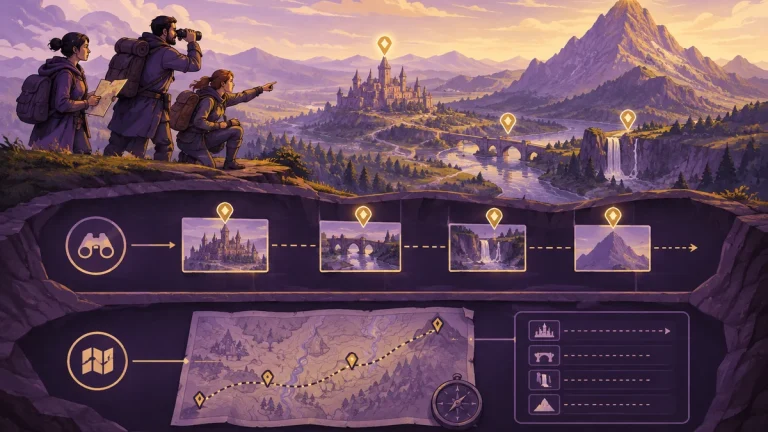
Titik Acuan Peta untuk Rotasi
Dalam banyak game online berbasis tim, landmark peta sering dipakai sebagai penanda arah agar semua orang…